Don’t Look Back

As the fall semester of English 111, section 116 ends, I am not looking back. Completion of this course pushes me one step closer to the completion of my program. I knew when signing up for this course that I would write and be able to check this class off my list of general courses to take, but I wasn’t told all the other parts I’d encounter; scrabble, direction to write snail mail, and the actual simplicity of this course, at least for me.

Not looking back at playing scrabble will be the hardest part. Spending essentially one fourth of class days shuffling lettered tiles to make simple words with almost complete strangers at 8am, only for classmates to challenge the simplest words, such as gnat. The days devoted solely to scrabble were the most enjoyable, although I feel more writing skills or other assets could have been learned in the time used to play the game.

While I might not be looking back to writing snail mail in class, I will continue to use this asset in the future. Even if it is only to send something simple like a hand-drawn picture of a bee, or “to send a Q-tip attached to a sheet of paper”, as Phyllis Diller chose to send, recorded in “We Could All Use a Little Snail Mail Now”. Snail mail is becoming so unfamiliar, my generation is probably one of the last that remembers snail mail as an actual method used to transfer information, instead of strictly electronic forms of communication that many kids learn now. I’m thankful snail mail was made a part of this class, not only for grades, but for opportunities to send and receive old-fashioned letters to those in a retirement home.
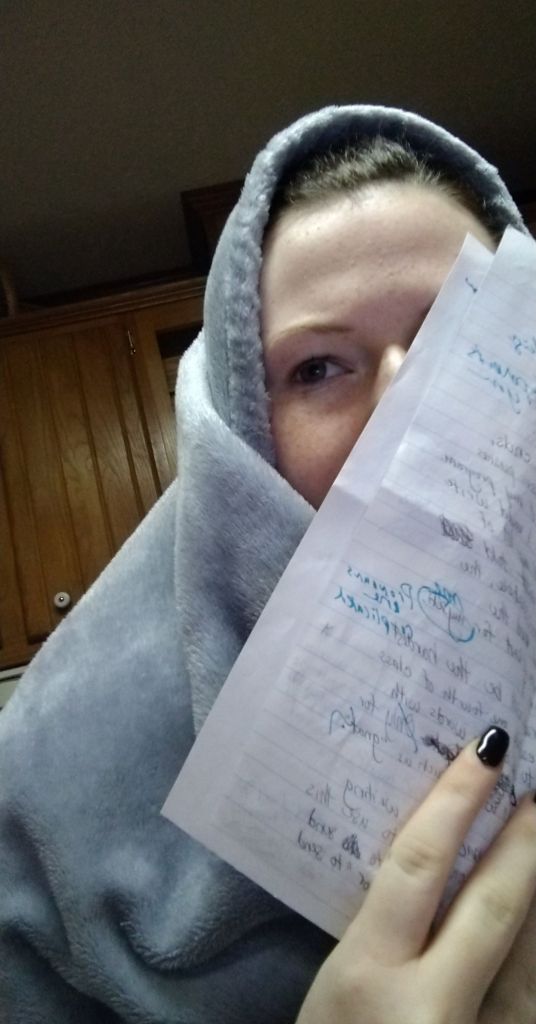
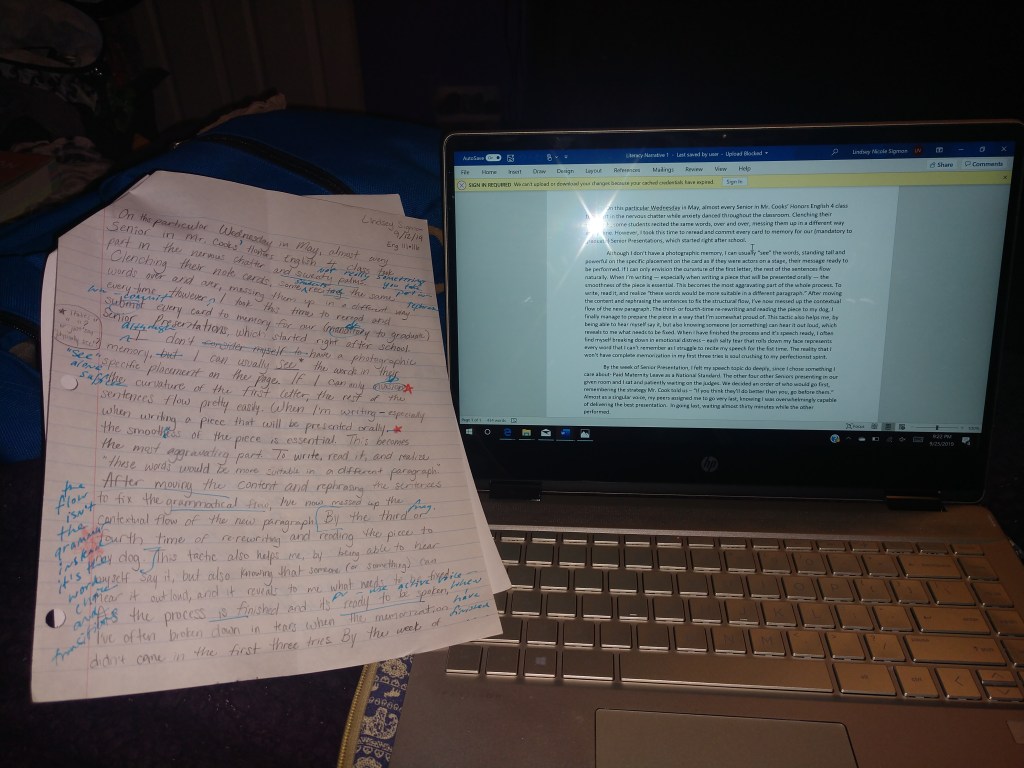
This picture is brought to you by my 3 hour nap after my Monday 8am class. When I woke up, I thought it was 2pm Tuesday the 3rd, and feared for my life I had missed class and the submission of my paper.

Additionally, I will not be looking back on this class as a whole due to its complexity or lack there-of. While it was a quite fun, and somewhat informative course, it has prepared me for the future college English courses no more than my high school English courses did. Maybe it’s due to the length of the course, but only having three major assignments in the span of 4 months does not engage me nearly as much as my year-long AP English III and Seminar course or even my Honors English IV course. I suppose the expectations of my former classes molded me into a being with even higher expectation for college classes, but perhaps my high school classes were educating me well beyond my first college English course.

Looking back at this course might only distract and give a false sense of hope and expectations for other future college classes. I’ve enjoyed and appreciated my time in this class but soon, it will be history. As said by Maryanne Wolf, “[t]here’s an old rule in neuroscience that does not alter with age: use it or lose it”. I personally would be alright to lose the knowledge acquired in this class for it was a repeat of high school English courses. In the words of Edna Mode from the movie The Incredibles, “I never look back, darling, It distracts from the now.”

Work Cited

Shain, Susan. “We Could All Use a Little Snail Mail Now.” The New York Times,

 8 October 2018, https://www.nytimes.com/2018/10/08/smarter-living/we-could-all-use-a-little-snail-mail-right-now.html. Accessed 14 November 2019.

Wolf, Maryanne. Skim reading is the new normal. The effect on society is profound.

The Guardian, 25 August 2018, https://www.theguardian.com/commentisfree/2018/

aug/25/skim-reading-new-normal-maryanne-wolf. Accessed 14 November 2019.

The Incredibles. Directed by Brad Bird, Pixar Animation Studios, 2004.
Tough Love

In Tara Westover’s brilliant memoir, Educated, she relives her childhood in Buck’s peak, Idaho, growing up under the control of her strict yet loving Mormon father, who refused to allow his numerous children to attend public school and now patiently waits for the end of times. Westover’s father shows love a little differently but, in his mind, has nothing but good intentions for her.

When dealing with her father, Tara knew the morals and ideas he had drilled into her head from an early age. When she was faced with worldly problems, she knew the appropriate response, and obeyed her father, even if she initially felt otherwise.

When Tara’s father brought home the Shear, everyone was either hurt by it or refused to operate it. Tara’s father, being the stubborn, work-driven man he is, demanded Tara to run the Shear. Initially, she resists, but is ultimately pulled to the metal deathtrap by her loyalty and allegiance to her father, despite her better judgement. Her father justifies his actions by saying on page 140 in Chapter 15, “She’s made of strong stuff” despite Tara being merely sixteen years old, and he recklessly rants about ownership of his crew. Her father’s work-forward demeaner and choice of words demands to be obeyed, leading to her acceptance of her father’s will for her.

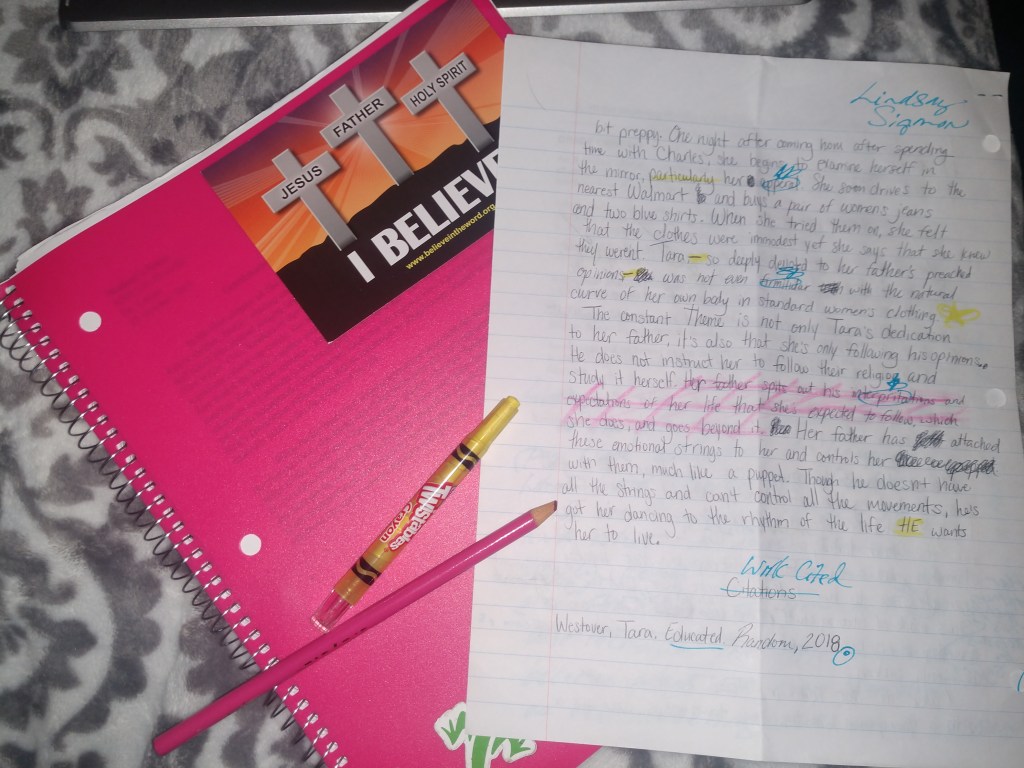
Later in her memoir, Tara is ‘going out’ with a young man named Charles who the whole town knows, and he is a bit preppy. One night after spending time with Charles, she begins to examine herself in the mirror, particularly her apparel. She soon drives to the nearest Walmart, on page 171 of Chapter 19, and buys a pair of women’s jeans and two blue shirts. Upon trying them on she felt immodest, yet she says that she knew the clothes weren’t. Tara — so deeply devoted to her father’s preached opinions — was not even familiar with the natural curve of her own body in standard women’s clothing.

The constant theme is Tara’s dedication to her father and her home. She always has and feels like she always will belong to Buck’s peak, so to act like she can drop her roots would be treason. Deep down, she trusts his opinions and continues to follow them for she knows that he’s trying to do what he thinks is best, maybe not always best for her, but will help or please someone else, even if its only himself. In some ways, her father has attached emotional strings to her which make her behave in this way, much like his own personal puppet. Though he doesn’t have all the strings and can’t control all of her movements, he has Tara dancing to the rhythm of the life he wants her to live.

Work Cited

Westover, Tara. Educated. Random, 2018.

I Struggle to Write and That’s Alright

 On this particular Wednesday in May, almost every Senior in Mr. Cooks’ Honors English 4 class took part in the nervous chatter while anxiety danced throughout the classroom. Clenching their notecards, some students recited the same words, over and over, messing them up in a different way every time. However, I took this time to reread and commit every card to memory for our (mandatory to graduate) Senior Presentations, which started right after school.

 Although I don’t have a photographic memory, I can usually “see” the words, standing tall and powerful in their specific placement on the card as if they were actors on a stage, their message ready to be performed. If I can only envision the curvature of the first letter, the rest of the sentences flow naturally. When I’m writing — especially when writing a piece that will be presented orally — the smoothness of the piece is essential. This becomes the most aggravating part of the whole process. To write, read it, and realize “these words would be more suitable in a different paragraph.” hurts my motivation to continue.  After moving the content and rephrasing the sentences to fix the structural flow, I’ve now messed up the contextual flow of the new paragraph. The third- or fourth-time re-rewriting and reading the piece to my dog, I finally manage to prepare the piece in a way that I’m somewhat proud of. This tactic also helps me, by being able to hear myself say it, but also knowing someone (or something) can hear it out loud, which reveals to me what needs to be fixed. When I have finished the process and its speech ready, I often find myself breaking down in emotional distress. Each salty tear that rolls down my face represents every word that I can’t remember as I struggle to recite my speech for the first time. The reality that I won’t have complete memorization in my first three tries is soul crushing to my perfectionist spirit.

By the week of Senior Presentation, I felt my speech topic do deeply, since I chose something I care about- Paid Maternity Leave as a National Standard. The other four Seniors presenting in our given room and I sat and patiently waiting on the judges. We decided an order of who would go first, remembering the strategy Mr. Cook told us – “If you think they’ll do better than you, go before them.” Almost as a singular voice, my peers assigned me to go very last, knowing I was overwhelmingly capable of delivering the best presentation.  In going last, I waited almost thirty minutes while the others performed. My mind took these thirty minutes as an opportunity to suggest every possible way I could stutter or forget to change slides. As I stood up and walked to the front of my room, the room seemed to grow as I took what felt like an endless walk of shame. Waiting for the judges to give me the “go-ahead’ felt like forever and a few short seconds at the same time. The waiting made my heart beat even faster, but I tried to use the short time to recite the speech one final time in my head. I started to inform my audience on the benefits and minimal drawbacks of National Paid Maternity Leave and before I knew it, I was close to the end, I had not skipped a beat, and I was ready to end my speech perfectly in the middle of the time specifications. Receiving a 97 on my Senior Project felt great. For me, speaking has always been a God-given talent I’ve never had much stage fright, and I’ve always enjoyed talking in general, Public speaking is a tool I will continue to use for the rest of my life. Looking forward, I would not be opposed to having to present in English 111 or any other future English class I may take, as I see it as a great opportunity to expand my skills and experience.

No, I’m Not A Pole Dancer

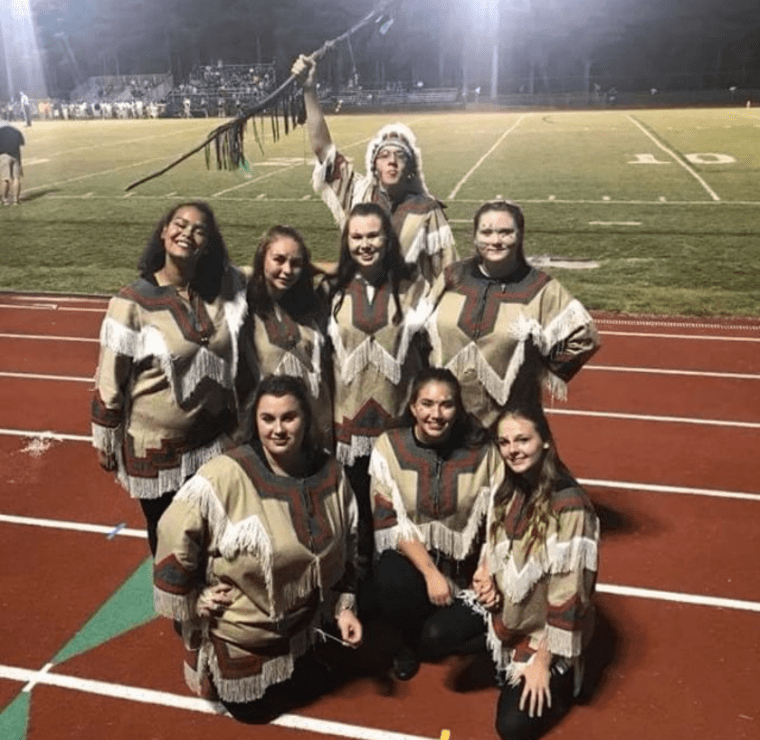
While most everyone else was on the stands on Friday night, I, and the rest of the West Iredell Color Guard Team was down on the track. We were dancing, chanting and performing the flag routine for our fight song every time our football team scored a touchdown.

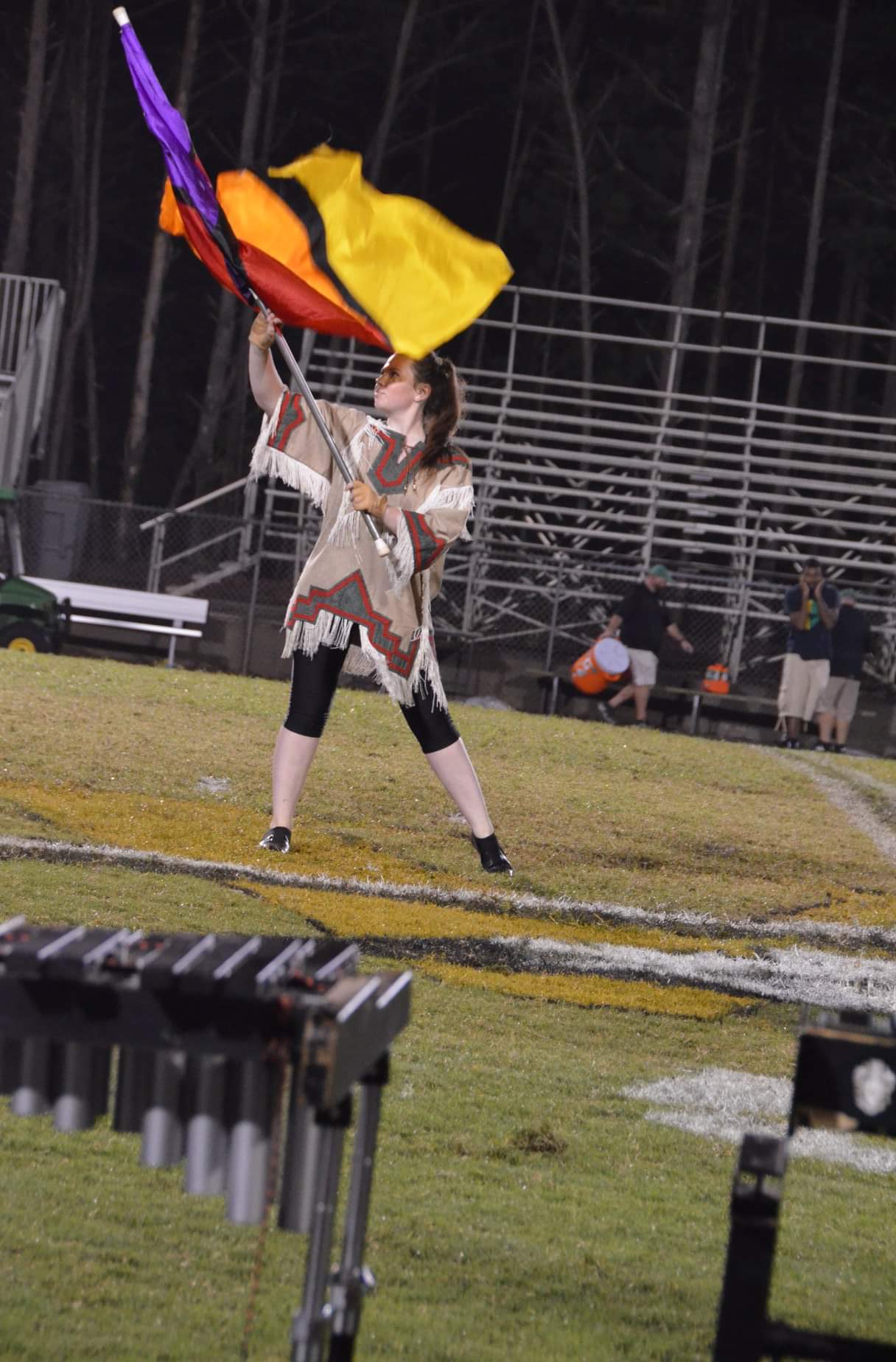
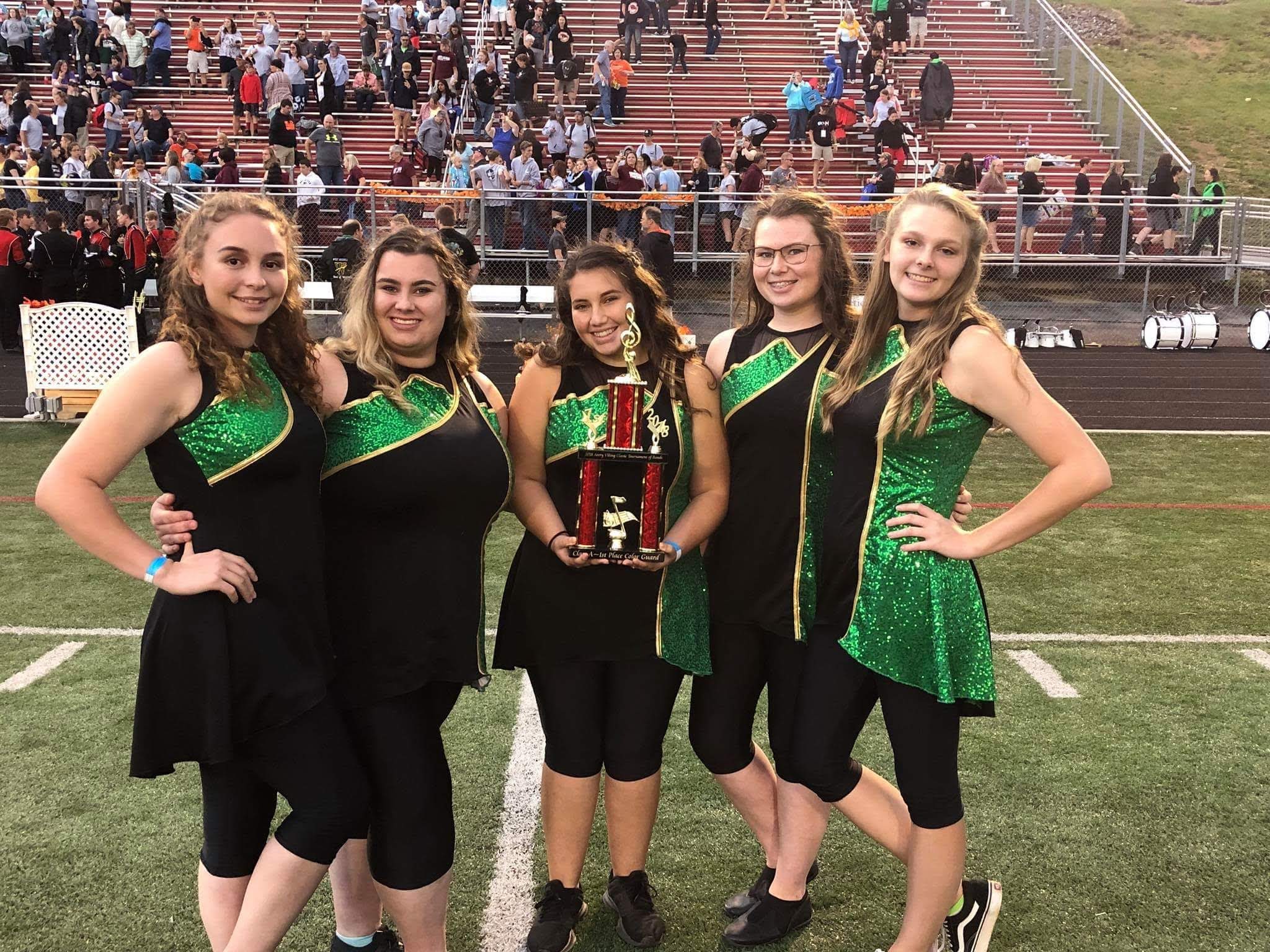
For the last two years of my high school career, I was on the color guard team which accompanies the marching band. Our team was never very large but we were the ones performing, with various flags, rifles, and other props at every half time show, competition, and parade every chance we got. Competitions were some of the best experiences where we got to share our show with other school and brought home numerous first place Color Guard trophies and plenty of memories. Many high school students don’t commonly care much for the marching band of know much about it so questions such as “You’re the ones who twirl the flags” and “Are y’all just fancy pole dancers?” were not unheard.

A band is not proud because it performs well; it performs well because it is proud. -George Parks.

Aside from the physical aspects of guard, spinning and performing, the girls and I had plenty of sleepovers and bonding experiences. Color guard strengthened my physically, gave me a new skill, and a new passion. Guard also allowed me to make the most out of high school life but built friendships that have outlasted high school. Color guard may not interest everyone, but for me, it was quite the catch!

Design a site like this with WordPress.com
Get started